
Hevy vs Strong vs Fitbod vs JEFIT: 10 Apps Compared
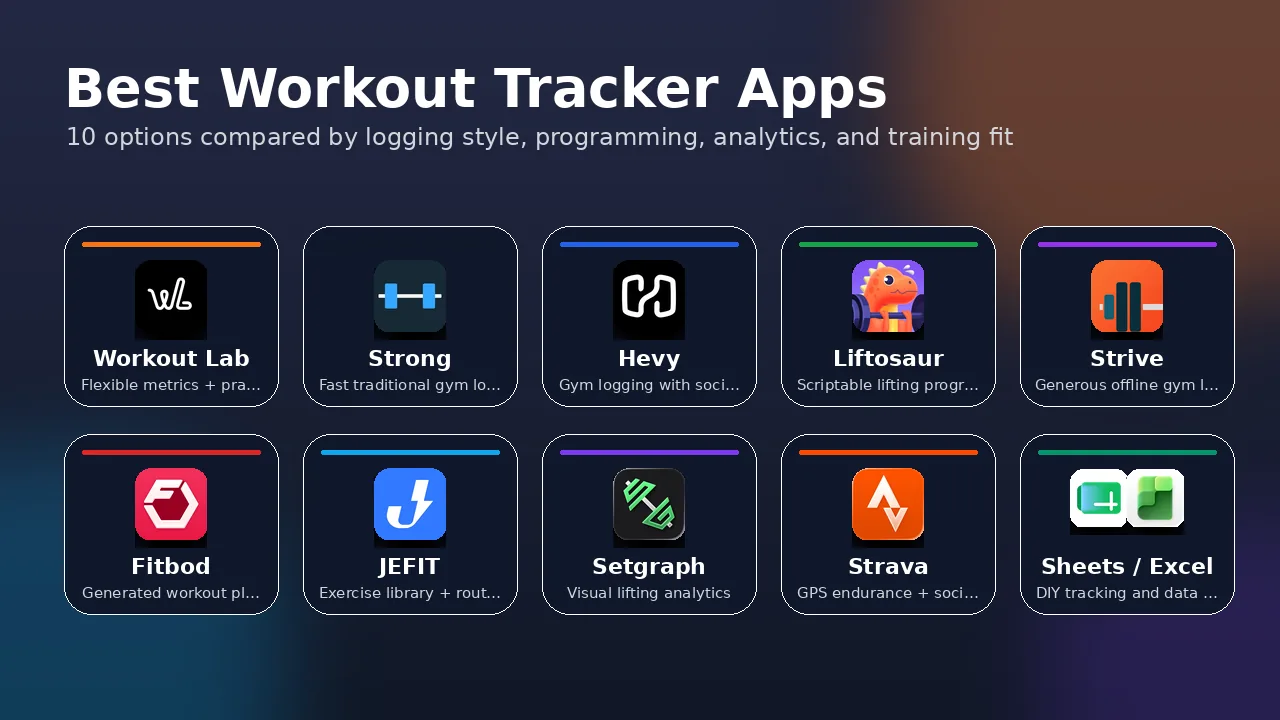
Short answer: Hevy and Strong suit conventional gym logging. Liftosaur suits lifters who want programmable progression. Fitbod generates workouts. JEFIT combines a large exercise library with routines. Strava handles GPS-based endurance training. Workout Lab suits mixed training that needs metrics beyond load and reps.
Are these workout trackers free or paid? Most have a free tier, free download, or trial. Strive, Hevy, Strong, JEFIT, Setgraph, Strava, Workout Lab, Google Sheets, and Excel web can all be used without an initial paid subscription, although their limits differ. Fitbod uses a trial before requiring a subscription for continued use. Paid plans range from a few dollars per month for several logbooks to roughly $16 per month for Fitbod in the US reference market.
Verified July 26, 2026. We checked material pricing, platform, and product claims against official product pages and public US app-store listings. Store prices, promotions, taxes, and legacy plans can vary by country and platform, so confirm the final amount in your local store.
Jump to pricing and free tiers, Hevy vs Liftosaur, Hevy vs JEFIT, Hevy vs Strong, the side-by-side feature table, or the final recommendations.
Quick answer: which workout tracker should you choose?
| Your main need | Start with | Reason |
|---|---|---|
| Fast standard gym logging | Strong or Hevy | Both focus on efficient sets, reps, load, routines, timers, and lifting history. |
| Social gym tracking | Hevy | Following friends, sharing routines, and public workout activity are central to the product. |
| Structured programs and progression logic | Liftosaur | Liftoscript, a web editor, and built-in programs support detailed lifting plans. |
| A generous offline gym log | Strive | Its official positioning emphasizes unlimited logging, no ads, and offline use. |
| App-generated workouts | Fitbod | Workout generation based on goals, equipment, and recent training is the core offer. |
| Exercise and routine discovery | JEFIT | Its large exercise database and routine ecosystem are stronger than those of smaller logbooks. |
| Visual analysis of conventional lifting | Setgraph | Session comparison, filtered set history, and lifting graphs are central features. |
| Running, cycling, routes, and GPS data | Strava | It is built around endurance telemetry, segments, routes, devices, and social sport. |
| Full DIY control | Google Sheets or Excel | You control the schema, formulas, charts, and files, at the cost of more setup and logging friction. |
| Strength, calisthenics, mobility, carries, and mixed training | Workout Lab | Each exercise can combine load, reps, RPE, time, distance, and range of motion. |
No app wins every category. A polished barbell log can be the wrong tool for planche holds or mobility measurements, while a flexible training log will not replace Strava’s GPS ecosystem or Fitbod’s generated programming.
Pricing and free tiers
The table uses public US pricing where an official US source exposed it. Workout Lab uses its owner-verified EUR reference prices because its confirmed pricing source is the app’s European store configuration.
| Option | Platforms | Free access | Paid price snapshot |
|---|---|---|---|
| Strong | iPhone, Android, Apple Watch | Unlimited saved workouts; up to 3 custom routines | Strong PRO: $4.99/month or $29.99/year. |
| Hevy | iOS, Android, web, Apple Watch, Wear OS | Free logging with limits on some routines and advanced features | Hevy Pro: about $2.99/month, $23.99/year, or $74.99 lifetime. |
| Liftosaur | iOS, Android, Apple Watch, web editor | Free download with in-app purchases | About $4.99/month, $39.99/year, or $99.99 lifetime. |
| Strive | iPhone, Android | Official copy promotes unlimited routines and logging without ads | In-app unlimited-access options are listed around $5.99, $39.99, and $119.99. |
| Fitbod | iOS, Android, Apple Watch, Wear OS | Trial; duration not stated in the reviewed store listings | The US App Store lists current monthly options from $12.99–$15.99 and yearly options from $79.99–$95.99. |
| JEFIT | iOS, Android, web, watch support | Free tier with routines, exercise library, and community | JEFIT Elite: about $12.99/month or $69.99/year. |
| Setgraph | iOS, Android, Apple Watch | Free base app | Pro: about $4.99/month, $29.99/year, or $199.99 lifetime. |
| Strava | iOS, Android, web, GPS devices, Apple Watch | Free activity recording and social features | The US App Store lists subscription purchases at $11.99 and $79.99; confirm the cadence at checkout. |
| Google Sheets / Excel | Web, desktop, mobile | Sheets is free with a Google account; Excel for the web is free | $0 can be enough. Microsoft 365 Personal is about $9.99/month or $99.99/year. |
| Workout Lab | iPhone, iPad, Android phones and tablets | Free tier plus 30 days of Pro; no payment method required to start | EUR reference: €3.99/month, €24.99/year, or €49.99 lifetime. |
Free does not mean identical access. Strong limits saved routines. Hevy reserves some routines and advanced analysis for Pro. Workout Lab keeps existing exercises and routines usable after the trial, but creating new custom exercises, offline use, and analytics require Pro. Export and import remain available on Workout Lab’s free tier. Check each app’s current plan page before moving years of training history into it.
Hevy vs Liftosaur
Choose Hevy if you want a familiar gym logger with social profiles, shared routines, friend activity, and support across phones, web, Apple Watch, and Wear OS. Its free tier is enough for many lifters whose sessions follow conventional sets, reps, and load.
Choose Liftosaur if program logic matters more than a social feed. Liftoscript can express progression rules, deloads, percentages, RPE targets, and set changes in a plain-text program. The web editor and built-in strength templates make it better suited to lifters who want the app to encode how a program progresses.
The distinction is social gym logging versus programmable lifting. Workout Lab serves a different need: representing exercises whose progress uses different combinations of load, time, distance, range of motion, reps, and RPE.
Hevy vs JEFIT
Choose Hevy for a cleaner social logging experience and routine sharing. Choose JEFIT when exercise-library breadth, pre-built routines, planning, and a long-established gym-training ecosystem matter more.
JEFIT’s official pages promote more than 1,400 exercises, workout plans, community features, watch support, and Elite analytics. Hevy’s product revolves around logging, following other lifters, sharing workouts, and viewing lifting charts. Both fit conventional gym training; the better choice depends on whether you value Hevy’s social workflow or JEFIT’s library and routine discovery.
Hevy vs Strong
Hevy and Strong overlap more than any other pair in this guide. Both handle sets, reps, weight, routines, timers, notes, personal records, and common lifting analysis.
Choose Strong if you want a mature, focused gym log and do not care much about a social feed. Choose Hevy if friends, public profiles, shared routines, web access, or Wear OS support affect whether you will use the app consistently. Test both logging flows during a real session; small interaction differences matter more than a long feature checklist when the core jobs are this similar.
How the apps compare
We used six decision criteria:
- Training model: standard gym lifting, generated programming, GPS endurance, or mixed metrics.
- Logging friction: how quickly you can record a working set or activity.
- Programming: whether the app stores workouts, supplies routines, generates sessions, or encodes progression logic.
- Analysis: what the history helps you inspect after training.
- Platform fit: phone, web, watch, tablet, and offline availability.
- Portability: whether you can export useful data if you leave.
The comparison does not award a universal score. A missing social feed is irrelevant to someone who wants a private training log, and a large routine library does not solve the problem of recording range of motion or carry distance.
Strong

Strong is a mature gym log for barbell, dumbbell, machine, and common bodyweight training. Templates, warm-up tools, plate calculation, rest timers, notes, Apple Watch support, and CSV export cover the needs of lifters who already know their program.
Its structure remains centered on conventional sets, reps, and load. Custom exercises help, but they do not turn Strong into a measurement system for every sport.
Best for: fast, focused strength and hypertrophy logging.
Hevy

Hevy combines gym logging with social activity. You can follow friends, share routines, use public profiles, and inspect charts for weight, volume, repetitions, sets, and estimated one-rep-max trends.
Hevy is a strong choice when training fits a standard gym model and accountability or community matters. Its conventional structure becomes less useful when one week includes holds, range-of-motion measurements, loaded carries, and conditioning tasks.
Best for: social gym logging across phone, web, and watches.
Liftosaur

Liftosaur focuses on programmable strength training. It includes built-in programs, a web editor, progression options, percentage work, RPE, timers, plate calculations, substitutions, body statistics, and Liftoscript.
That power has a learning cost. It rewards lifters who want to control progression rules and program structure. Someone who only needs a quick log may prefer Strong or Hevy, while someone tracking many movement types may prefer a more flexible metric model.
Best for: structured lifting programs and power-user progression logic.
Strive

Strive, listed in stores as Gym log - Strive, emphasizes unlimited routines, workout logging, no ads, and offline use. Official descriptions also list RIR/RPE, rest timers, measurements, notes, multiple set types, personal records, charts, deload markers, workout sharing, and Apple Health or Health Connect integration.
It is a practical option for regular strength or hypertrophy training when free access and offline logging matter. The product still follows a gym-log model rather than an open-ended mixed-sport measurement system.
Best for: a generous offline gym log.
Fitbod

Fitbod generates workouts from your goals, equipment, available time, experience, and recent training. That removes programming work for someone who wants guidance instead of building a plan from scratch.
The subscription costs more than most pure logbooks because generated programming is the main product. Athletes following a coach’s plan, a scripted strength block, or a skill progression may not need that layer.
Best for: people who want the app to choose their workouts.
JEFIT

JEFIT combines a large exercise database, pre-built and custom routines, workout plans, community access, progressive-overload tools, and lifting analytics. It has more routine-discovery infrastructure than most smaller trackers.
Library size helps when the exercise and tracking format you need already exist. It matters less when you need to define a custom movement and choose a different measurement model for it.
Best for: exercise discovery, routines, and conventional gym planning.
Setgraph

Setgraph gives conventional lifting a visual-analysis focus. Official materials highlight comparison with previous sessions, dynamic graphs, filtered set history, one-rep-max tables, calendar views, workout planning, notes, Apple Watch support, Apple Health sync, and generated workouts.
It fits lifters who want more visual feedback than a basic logbook. Range of motion, negative-load assistance, carry distance, and skill-hold duration are not its central model.
Best for: gym trainees who want fast logging and detailed lifting graphs.
Strava

Strava is an endurance activity platform rather than a detailed strength log. It handles running, cycling, hiking, routes, segments, clubs, challenges, GPS devices, and social activity better than any gym tracker in this comparison.
Many hybrid athletes need Strava and a strength log because the products store different kinds of evidence. Route, pace, elevation, and device telemetry belong in Strava. Per-exercise load, repetitions, range of motion, and skill holds belong in a workout log.
Best for: endurance telemetry, routes, segments, and social sport.
Google Sheets and Excel

Spreadsheets can represent almost any training system. You choose the columns, formulas, charts, dashboards, and sharing rules. Google Sheets works well for collaboration, while Excel offers deeper analysis for people comfortable with PivotTables and structured data.
You also build and maintain the interface. A spreadsheet does not provide a native set-completion flow, exercise picker, previous-set prompt, or phone interface designed for training unless you create those systems yourself.
Best for: total control and custom analysis with manual upkeep.
Workout Lab

Workout Lab lets each exercise use its own combination of load, repetitions, RPE, time, distance, and range of motion in centimeters. A squat can use load, reps, and RPE. A front lever can use hold time. A farmer’s walk can use load, distance, and time. A band-assisted pull-up can record assistance as negative load and progress toward zero.
That model serves athletes who mix strength, calisthenics, mobility, carries, conditioning, and custom exercises. Workout Lab does not supply Fitbod’s generated workouts, Liftosaur’s scripting language, Hevy’s social network, JEFIT’s library, or Strava’s GPS ecosystem.
The free tier remains usable as a training diary after the 30-day Pro trial. Existing exercises and routines stay available, and users can keep creating workouts or adding existing exercises to them. Pro is required for new custom exercises, offline use, and analytics. Both tiers can export and import Workout Lab JSON backups; third-party Strong or Hevy imports are not supported yet.
Best for: mixed training that requires different measurements for different exercises.
Side-by-side features
| Option | Best fit | Free entry | Main tradeoff |
|---|---|---|---|
| Strong | Fast standard lifting log | Yes, with routine limits | Fixed gym-log structure |
| Hevy | Social gym tracking | Yes, with Pro limits | Fixed gym-log structure |
| Liftosaur | Programmable lifting | Free download | More setup and a lifting-first model |
| Strive | Offline gym logging | Generous free access | Gym-focused measurement model |
| Fitbod | Generated workouts | Trial; duration not stated in reviewed listings | Subscription required after the trial |
| JEFIT | Exercise library and routines | Yes | Breadth does not equal custom metric flexibility |
| Setgraph | Conventional lifting graphs | Free base app | Gym-focused measurement model |
| Strava | GPS endurance and social sport | Yes | Not a detailed strength or mobility log |
| Sheets / Excel | DIY control | Yes | Manual setup and phone logging friction |
| Workout Lab | Mixed training metrics | Free tier plus 30 days of Pro | No generated programs, social feed, watch app, or native GPS tracking |
“Custom exercise” can mean selecting a name inside a fixed sets-and-reps model, or defining the measurements that apply to the exercise. Test the exact workflow you need before subscribing.
Data portability and switching costs
Training history becomes more valuable as it grows, so check export options before committing to a tracker. Strong documents CSV export. Workout Lab exports and imports its own JSON backup on both Free and Pro, but it does not currently import Strong, Hevy, or other third-party formats. Spreadsheets remain the easiest files to inspect and transform yourself.
For every other app, verify the current export path in official support documentation or ask support before assuming that an account export will produce a reusable workout dataset. Cloud sync, health-platform integrations, and downloadable training files solve different problems.
Which workout tracker should you choose?
Choose Strong for a mature, focused gym log. Choose Hevy when social training and shared routines matter. Choose Liftosaur for programmable lifting, Strive for generous offline gym logging, and Fitbod when you want generated workouts.
Choose JEFIT for its exercise and routine ecosystem, Setgraph for conventional lifting graphs, or Strava for GPS-based endurance training. A spreadsheet remains the strongest option when full DIY control outweighs logging convenience.
Choose Workout Lab when the same week includes exercises measured in different ways. You can inspect how flexible tracking works across sports, why the data you collect matters, and how to build a custom exercise library before downloading the app.
Related Articles
How to Track Strongman Events and Progress
Learn what to record for carries, stones, presses, pulls, throws, and medleys so you can compare your strongman training over time.
How to Track HYROX Training: Runs, Stations, and RPE
Learn how to log HYROX runs, stations, mixed sessions, and preparation exercises without turning your training into a spreadsheet project.
How to Measure Mobility Progress: A Repeatable ROM Tracking System
Learn how to measure mobility progress with standardized ROM targets, repeatable exercises, and session data instead of occasional photos and guesswork.