
How to Track HYROX Training: Runs, Stations, and RPE
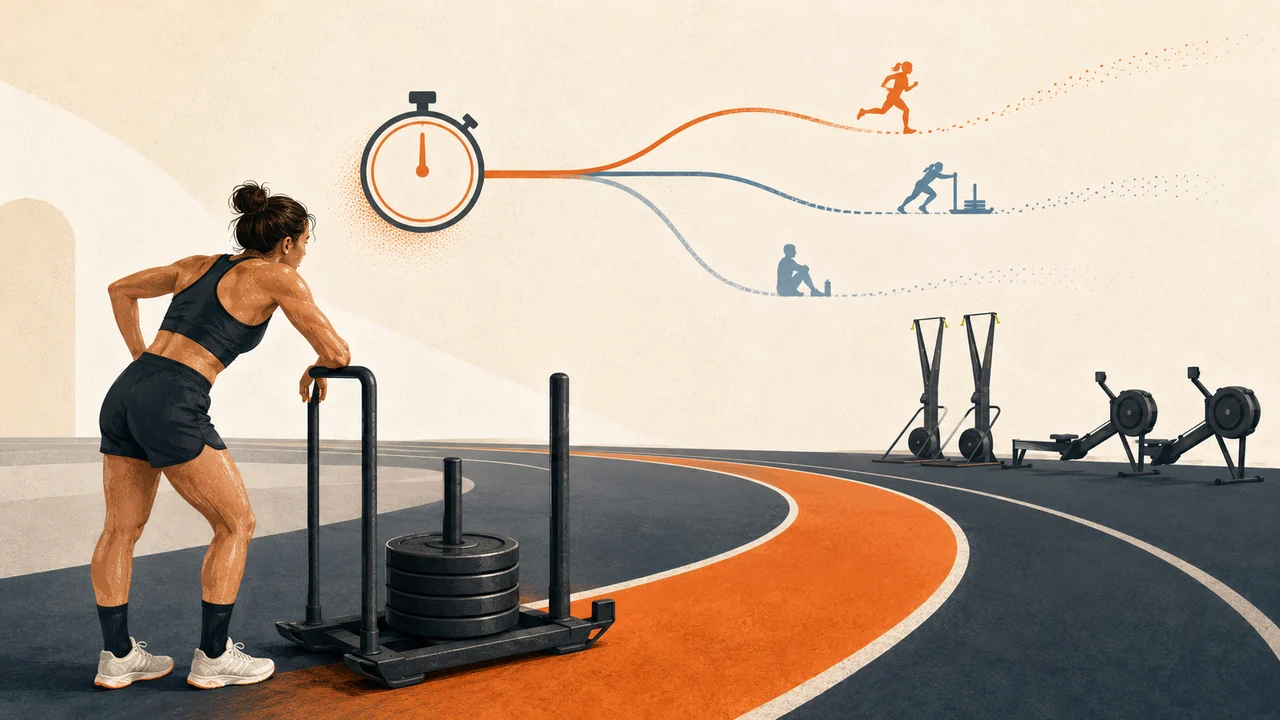
You finish a hard HYROX session, stop the clock, and see a time that looks pretty good. A week later, you repeat the workout and finish 30 seconds faster. You’d take that. The interesting part is knowing where those 30 seconds came from.
Maybe your running improved while the sled slowed down. You might have held the same pace with less effort, or used a different surface, load, or rest period. The final time hides all of this. A short training log keeps it visible.
The word log may bring to mind a complicated spreadsheet filled with numbers. In practice, a useful HYROX record can be small: what you planned, what you completed, the few numbers that mattered, anything important that changed, and how hard the session felt.
That small habit helps you see progress that is easy to miss, understand where a session started to fall apart, and choose what to repeat next. A notebook or spreadsheet can do the job. The challenge is keeping runs, stations, and unusual preparation exercises together without forcing them all into the same format.
Why logging HYROX training is worth the effort
HYROX combines several types of work in one event. The current Singles format alternates eight 1 km runs with SkiErg, Sled Push, Sled Pull, Burpee Broad Jump, Rowing, Kettlebell Farmers Carry, Sandbag Lunge, and Wall Balls (HYROX Singles Rulebook, Season 26/27, accessed July 26, 2026).
Your training is usually broader than that list. A training week might include normal run intervals, hill work, strength exercises, heavy carries, step-ups, sled drags, rowing intervals, sandbag work, or a circuit that mixes several of them. These exercises prepare you for the demands of HYROX, even when they are not official race stations.
This is where a normal gym log often becomes awkward. Load and reps work well for squats or presses. They tell only part of the story for a farmer’s carry, where load, distance, and time may all matter. A hill interval may need time, distance, and incline. A static hold may need duration, body weight, added load, or the position you held. Mixed sessions also need the order of the work, because a run after a sled push is different from the same run while fresh.
Without a clear record, you are left with memory and a final time. Both can be misleading. Sessions that feel terrible sometimes contain a strong run split or a better final round. Sessions that feel great may have used an easier setup. Logging gives you something concrete to compare.
The same total can hide two different sessions
Imagine the same athlete repeats the same mixed session under the same setup:
| Session | Running | Stations | Rest and changeovers | Session RPE | Total |
|---|---|---|---|---|---|
| A | 15:00 | 14:00 | 3:00 | 8 | 32:00 |
| B | 14:20 | 14:40 | 3:00 | 9 | 32:00 |
The final time did not move. Inside the session, running was 40 seconds faster, station work was 40 seconds slower, and the athlete rated the second session as harder. That is already more useful than “no progress.” It gives the athlete a sensible question for the next session: can the quicker running be repeated without losing time on the stations?
The comparison only works because the planned work and conditions matched. If the sled, surface, distance, rest, or exercise order changed, keep the result but treat it as a different session rather than forcing a conclusion.
What to record without making it complicated
Start with five things:
- What was the session meant to work on?
- What did you plan, and what did you actually complete?
- Which number best describes each important task?
- Did anything change enough to affect the comparison?
- How hard did the whole session feel?
That is enough for most sessions. More detail only earns its place when it helps you answer a real question.
Give the session one clear purpose
A session called “HYROX workout” will be hard to find or interpret later. Use a name that tells you what happened, such as “Four mixed rounds: run, SkiErg, sled” or “Sled push repeats with fixed rest.” Then write the main question in plain language.
You might want to know whether your 1 km intervals stay consistent, whether you can maintain a sled load across several efforts, or how much a station affects the run that follows. Choosing one question makes the rest of the log easier. You only need the numbers that help answer it.
Keep the plan and the completed workout side by side. If you planned four rounds but stopped after three, record three. If you used a lighter sandbag in the final round, note the change. The session still contains useful information; it simply answers a slightly different question.
Choose numbers that fit the exercise
Most HYROX work falls into a few simple patterns. Runs and machines usually need distance and time. Loaded movement usually needs load, distance, and time. Rep-based work usually needs reps, load, and sometimes time.
The same logic works for preparation exercises that never appear as official stations:
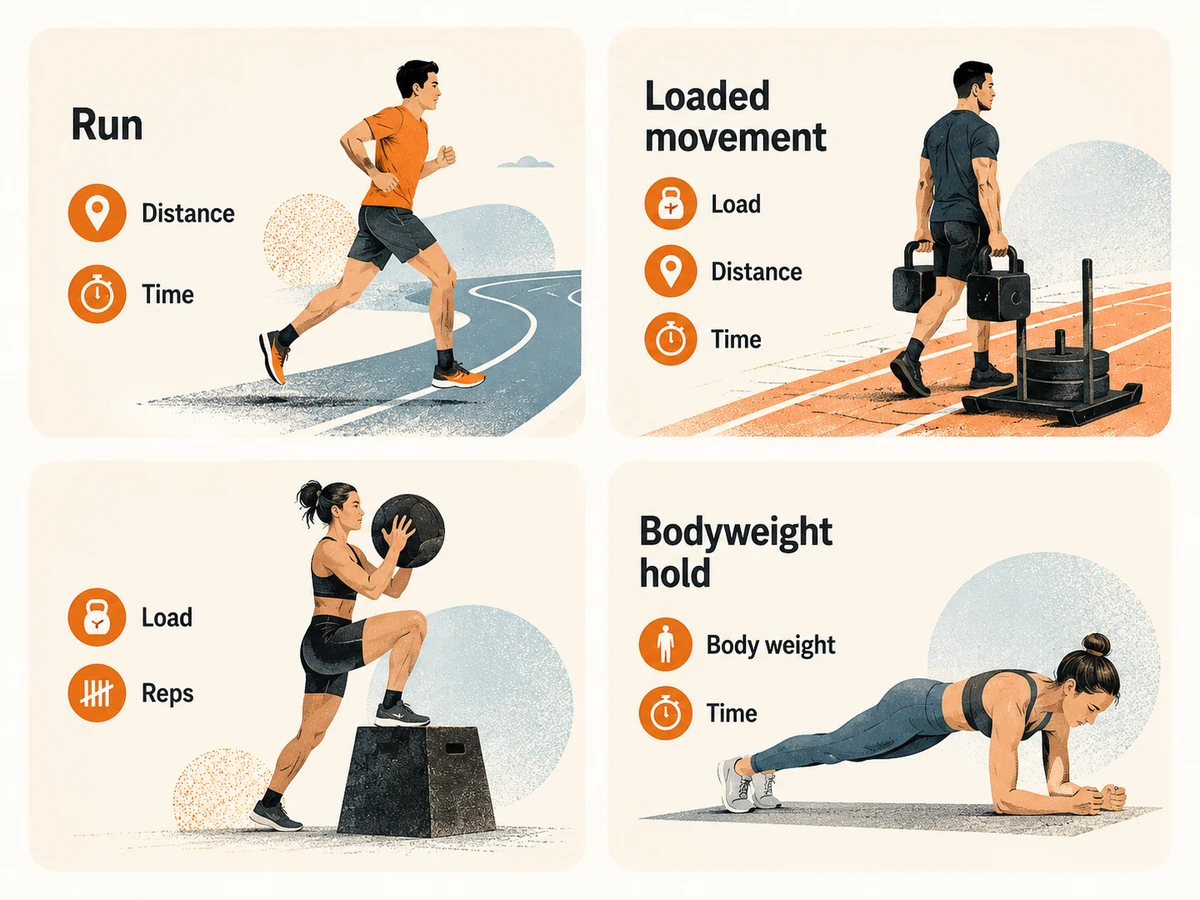
Use the numbers that fit the exercise. Most sessions need less data than you think.
| Type of work | Examples | Useful numbers |
|---|---|---|
| Cover a distance | Run, SkiErg, Row, burpee broad jump | Distance and time |
| Move a load over distance | Sled, carry, sandbag lunge | Load, distance, and time |
| Complete repetitions | Wall balls, step-ups, strength work | Reps, load, and optional time |
| Hold a position | Wall sit, plank, grip hold | Time, body weight, added load, or assistance |
| Repeat a circuit | Run plus two or more exercises | Round time and the main result from each exercise |
You will rarely need every possible field. A farmer’s carry may need load, distance, and time because each one changes the result. A strength set may only need load and reps. If recording a split interrupts the workout, write it down when the interval ends.
When you are practising race standards, use the current HYROX rulebook index for your division. This guide is about recording training, not prescribing race loads or standards.
Add context when it could change the result
A short note can save a misleading comparison later. Sled work is the clearest example. The same listed load can feel very different on another sled or floor. Run times can change with the route, gradient, surface, or weather. Carry times can change if one session uses tight turns and another uses a straight path.
You do not need a diary entry beside every round. Ask one question: could this detail explain a meaningful change in time, load, reps, or effort? If yes, record it. If no, leave it out.
Use the same rule for timing. Decide whether the session total covers the main work only or everything from warm-up to finish. Keep planned rest separate from task time. If you did not time a changeover, preserve the exercise order without inventing a transition split.
Use RPE as a simple effort note
RPE is a 1 to 10 rating of how hard the work felt. A session RPE gives the entire workout one effort score. Ask yourself the same question at roughly the same point after each workout: “How hard did the whole session feel?”
This gives the numbers useful context. Completing the same work at RPE 7 instead of RPE 9 may be worth noticing even if the clock barely moved. The score cannot tell you why the workout felt easier or harder, and it should not be used as a diagnosis. It is simply a quick record of your experience. Reviews of session RPE and training monitoring support it as a practical personal measure when the prompt and timing stay reasonably consistent (Haddad et al., 2017; Halson, 2014).
Task-level RPE is optional. Use it when the effort of a particular run or station answers your session question. Do not average several task ratings and call the result session RPE. They describe different things.
How to log common HYROX sessions
The fields stay simple, but their arrangement changes with the workout.
One task or a task-run pair
When you train one task on its own, keep separate efforts only if you care about how the result changes across the sets. Three sled pushes might each have the same load and distance, with a time for each effort and the planned rest between them. If the total completed work is all you need, one total is enough.
When the point is running after station work, pair each station with the run that follows:
- Round 1: sled push time, then 800 m run time
- Round 2: sled push time, then 800 m run time
- Round 3: sled push time, then 800 m run time
Now you can see whether the run slowed, the sled slowed, or both changed together. A total running time would hide that pattern.
Repeated mixed rounds
A mixed session needs the work in its real order. Here is one illustrative example:
- Purpose: see how the run changes across four matched rounds
- Plan: 600 m run, 300 m SkiErg, 15 m sled push at 80 kg plate load, then 0:45 rest
- Completed: four rounds as planned
- Setup: indoor 200 m track, same SkiErg, same sled and rubber floor
- Session RPE: 8, recorded about 20 minutes later
| Round | 600 m run | 300 m SkiErg | 15 m sled push | Rest |
|---|---|---|---|---|
| 1 | 2:54 | 1:20 | 0:35 | 0:45 |
| 2 | 2:58 | 1:23 | 0:38 | 0:45 |
| 3 | 3:03 | 1:26 | 0:42 | 0:45 |
| 4 | 3:07 | 1:30 | 0:46 | None after the final round |
The complete session took 22:37. More importantly, the record shows that every task slowed across the rounds. The log does not explain the cause, but it gives the next session a useful comparison: repeat the same setup and see whether the pattern changes.
For a simulation, record the planned format, the work you completed, the total time, and any important changes. Note a shortened distance, different load, extra rest, or altered order. A gym stopwatch is still a training record, not official race timing.
Detailed transition timing and race-style debriefs can become a separate process. For an ordinary log, keep enough structure to understand the workout without turning every changeover into another data-entry job.
Turn a week of logs into one useful decision
Reviewing your log should take minutes, not become another workout. Find a session you can compare and ask three questions:
- What got better, held steady, or slowed down?
- Did the setup or effort change enough to explain it?
- What is worth repeating next week?
Use the record before looking for an explanation. “My final two runs slowed” is an observation. “My running fitness got worse” is a conclusion the log cannot support from one session. Perhaps the preceding station took more out of you, the route changed, or you simply had a difficult day. Keep the honest observation and use the next comparable session to learn more.
If you want a broader review process for your complete training week, read How to Review Your Training Data.
Use Workout Lab for training that does not fit a template
Most workout trackers are comfortable with a familiar entry such as three sets of ten repetitions at 60 kg. HYROX preparation regularly asks for something else.
A farmer’s carry may need load, distance, and time. A sled push may use the same three fields, yet require a different note about the surface and sled. A run after wall balls needs distance and time, while a weighted step-up might need body weight, added load, reps, and range of motion. A mixed circuit needs several exercises in a deliberate order.
Workout Lab is built around that flexibility. Each exercise can use the measurements that fit it, including load, reps, time, distance, range of motion, and RPE in any combination. The app also supports body-weight tracking for bodyweight exercises. You do not have to force every exercise into a bodybuilding-style load-and-reps entry.
Start by searching the exercise library. If the movement or field setup you need is missing, create an exercise and choose the measurements that suit it. The custom exercise library guide covers the setup details.
For a mixed workout, add the exercises in order and use each set number as a round. Short exercise notes can hold the route, equipment, rest rule, or an important change. The result is a readable session history without building a new spreadsheet for every workout.
Workout Lab keeps the log flexible, but you still choose the useful numbers and enter them. If you track a run with a watch, carry across the few results that matter to the mixed session instead of rebuilding the whole watch record.
For more examples of matching metrics to different kinds of training, see Workout Tracking for Any Sport.
The first clean entry does not need to describe your entire HYROX plan. Choose the next session you expect to repeat, name its purpose, and record the few results that will make the next comparison useful. If you want one place to build that flexible log, open Workout Lab and set up the exercises around the way you actually train.
Start Tracking Your Progress
Turn your training data into actionable insights with Workout Lab.
Get Started FreeRelated Articles
How to Track Strongman Events and Progress
Learn what to record for carries, stones, presses, pulls, throws, and medleys so you can compare your strongman training over time.
How to Measure Mobility Progress: A Repeatable ROM Tracking System
Learn how to measure mobility progress with standardized ROM targets, repeatable exercises, and session data instead of occasional photos and guesswork.
Your Workout Week in Data: How Automated Weekly Reports Surface What's Actually Happening
A weekly workout report surfaces volume trends, RPE patterns, and Est. 1RM trajectory automatically. Here's what to track and how to act on it.