
How to Review Your Training Data: A Beginner's Weekly and Block-End Checklist
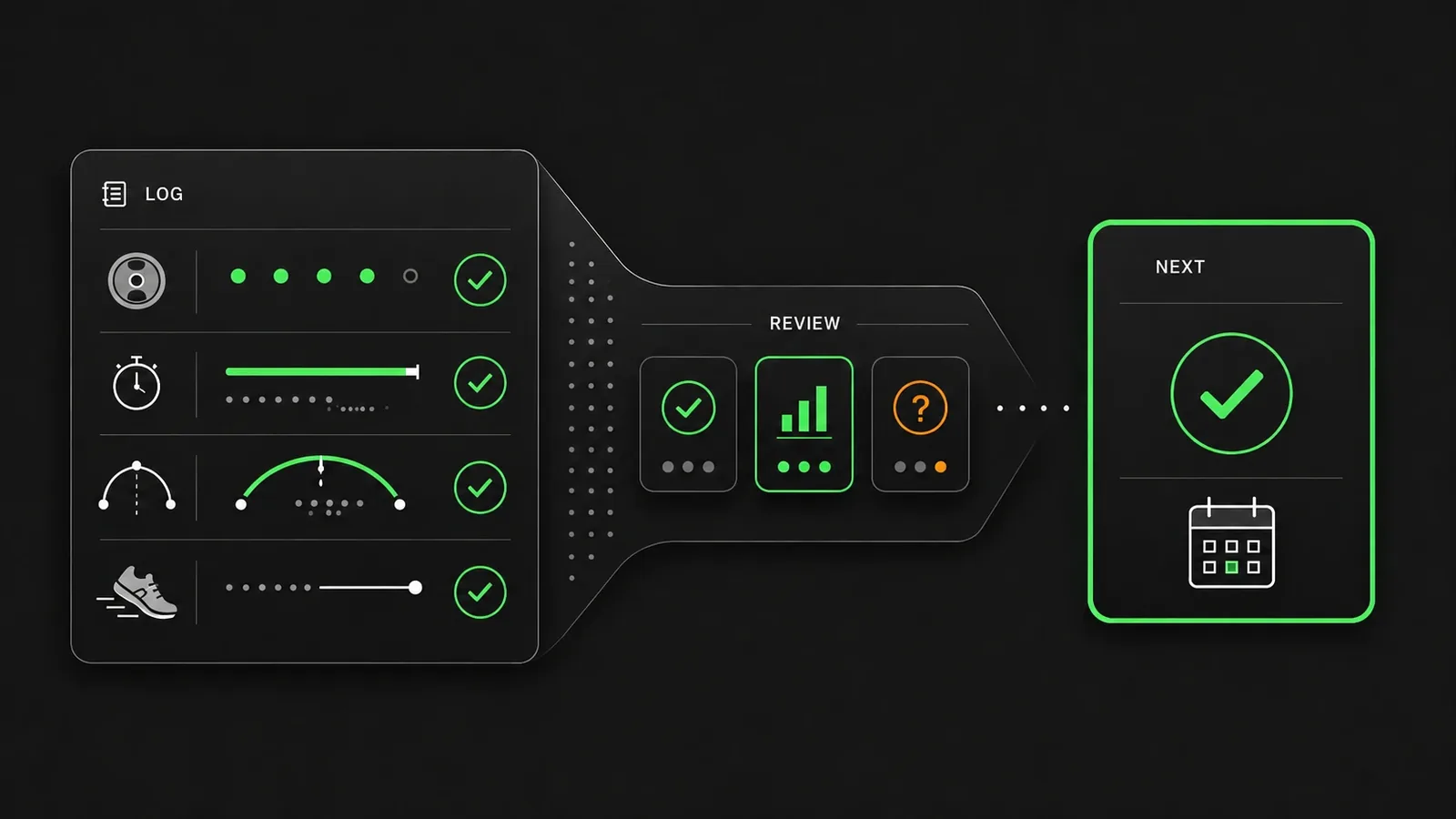
You have a notebook full of workouts. Maybe you have a spreadsheet or a few weeks of history in an app. You wrote down the exercises, sets, weights, times, distances, or hold durations because tracking was supposed to help.
Then you look back at all those numbers and think: now what?
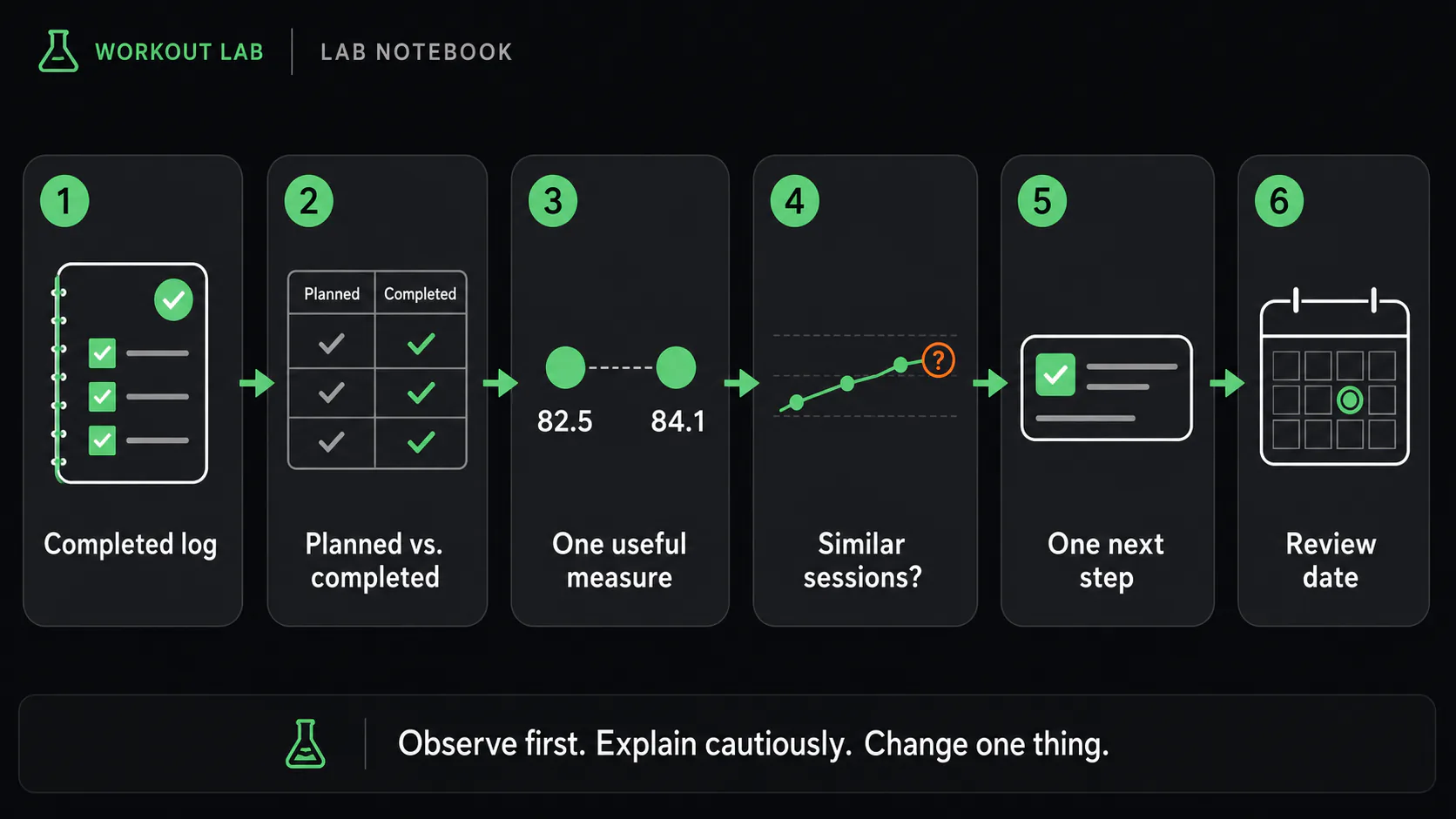
The good news is that reviewing your training is much simpler than it sounds. You do not need to study every number, understand sports science, or build a complicated dashboard. A useful review can start with four questions:
- What did I plan to do, and what did I actually do?
- What is the one result I care about most right now?
- Am I comparing it with a similar session?
- What is one sensible thing to do next?
A quick look each week helps you keep the plan and the log on track. A longer look after a training block, meaning a group of weeks spent following the same plan, helps you see whether a real pattern is forming.
That small habit can show you progress that is hard to feel day to day. It can also stop one bad workout from convincing you that everything needs to change.
If your records are still inconsistent, start with what to track in your workouts and why it matters. If you already have a few logged weeks, you have enough to begin.
Start with one thing that is worth checking
The fastest way to make training analysis feel overwhelming is to look at everything at once. A log can contain a lot: load and reps, time or distance, RPE, session length, rest time, and more. You only need a small part of it today.
Start with the goal of the training you are reviewing. Then choose one measure that represents it well enough.
If you want to improve your squat, you might follow the load and reps you can complete on the same working set. If you are working on pull-ups, you might track reps with the same band and setup. For a handstand, a controlled hold time may tell you more than the total length of the session. For running, a familiar route or repeated interval gives you something useful to compare.
If you record how hard the work felt, keep that note beside the result. The same load and reps can feel different from one session to the next. That difference gives you useful context without explaining the cause.
The measure only needs to represent the current goal. It does not need to cover every part of your training.
Pick a measure that matches the goal
| What you are training | One useful measure | Details that make the comparison fair |
|---|---|---|
| Strength | Load and reps on the same lift or close variation | Range of motion, rest time, setup, how hard the set felt |
| Calisthenics | Reps, hold time, or assistance on the same progression | Band, anchor point, what counts as good form, whether you include bodyweight |
| Mobility | The same range-of-motion measurement | Warm-up, reference points, direction, time of measurement |
| Conditioning | Time for a fixed route, distance, interval, or task | Route, weather, rest, equipment, how hard it felt |
Those extra details matter because two numbers can look comparable when the sessions were quite different.
Ten pull-ups with a light band are not the same as ten with a heavier band. A 5K on a cool, flat route is different from a hilly run in the heat. A mobility measurement taken cold will not tell you the same thing as one taken after a long warm-up.
You can still record those sessions. Just avoid forcing them into a comparison that does not fit.
Keep the review small
A notebook or spreadsheet is enough. Use one row for each week or review period:
| Period | What I planned | What I completed | One measure | Was the comparison fair? | What I noticed | One next step | Look again on |
|---|---|---|---|---|---|---|---|
| Week 2 | 3 bench sessions | 2 completed | 80 kg × 5 | Only one session used the planned rest | I need another similar session before judging | Make the third session easier to schedule and keep rest consistent | End of week 3 |
The table does not need to produce an exciting answer every time. “I cannot compare this fairly yet” is useful. It tells you exactly what to clean up before the next review.
Take five minutes at the end of each week
Your weekly review is a check-in, not an exam. You are trying to answer three familiar questions:
- Did I do what I planned?
- Can I fairly compare this week’s result with the last one?
- What should I keep or tidy up next week?
That is enough. You are not deciding the future of the whole program every Sunday.
Did you do what you planned?
Start with the sessions. How many did you plan, and how many did you complete? Then look inside them. Did you perform the main exercise or task? Did you complete the sets or intervals that mattered most?
Suppose you planned three strength sessions and completed two. That does not mean the program failed. It also does not mean you lacked motivation or recovered poorly. It means you have less information than expected.
The useful next question is practical: why did the third session not happen? If the same scheduling problem keeps appearing, adjusting the schedule may help more than changing the exercises.
Are you comparing the same thing?
Now look at your chosen measure. Compare it with the previous week only if the sessions are similar enough.
Maybe your squat felt harder, but you rested for one minute instead of three. Maybe your run was slower, but the route was hillier. Maybe your fingertip-to-floor measurement changed because you used a different warm-up.
Write down those differences. They are not excuses. They are part of the workout.
One poor session under different conditions should become a note for next time, not a reason to rewrite the plan.
Write one observation and one next step
Keep the observation close to what you can see in the log:
I completed two of three sessions. My main working set matched last week, but it felt harder.
Avoid jumping straight to an explanation:
I am under-recovered and need a deload.
The first sentence gives you something you can check again. The second guesses at a cause that the log cannot confirm.
Your next step can be small:
- repeat the same session under similar conditions;
- use the same band, route, warm-up, or rest time;
- move a session to a day that fits better;
- keep the plan as it is and collect another week;
- save one question for the end of the block.
Choose one. Then write the date when you will look again.
Take a longer look at the end of a training block
A training block is simply a group of weeks in which you follow the same general plan and work toward the same goal. The end of that period is a better time to step back and look for a pattern.
Return to the same measure you chose at the start. The other numbers can stay in the log unless they help explain the comparison.
Begin with the goal and the work you completed
Write down what you wanted to improve. Then look at how much of the planned training you completed and whether the main task stayed consistent.
Imagine that your goal was to improve your pull-ups, but you used three different bands, changed the anchor point, and missed several planned sessions. The block may still have been useful, but it does not give you a clean answer about pull-up progress.
That finding already helps. Your next block may need a more consistent setup or a plan that fits your week better.
Line up a few similar sessions
Put the most comparable sessions next to each other. You are looking for a direction, not a perfect graph.
Did the same load move for more reps? Did a hold last longer with the same progression and form? Did the same route become faster at a similar effort? Did the same mobility measurement change when you used the same warm-up and reference points?
A single result may bounce around. Several similar sessions can show whether the measure is generally improving, staying flat, getting worse, or still too messy to judge.
Separate what you see from what you are guessing
Use three short lines:
What I can see: What happened across the similar sessions?
What I do not know: Which conditions changed, or what could the log not tell me?
What I will do next: What is the smallest useful step before I review again?
For example:
What I can see: The same squat session felt harder three times, even though I completed most of the planned work.
What I do not know: My rest and setup were not consistent enough to tell why.
What I will do next: I will keep the rest and setup the same for the next two sessions, then look again.
This keeps a useful pattern from turning into a hard conclusion too soon. If the pattern continues and you want to judge the whole plan, move on to how to know whether your workout program is working.
Match the next step to what you found
Choose a next step that makes sense for the information you have.
| What you see | A sensible next step | Avoid concluding that… |
|---|---|---|
| Your chosen measure improves across similar sessions | Continue and choose the next review date | The whole program is perfect |
| The measure stays flat, but you missed much of the planned work | Make the plan easier to follow, then compare again | The program failed |
| The measure stays flat and the same task keeps feeling harder | Check the setup and notes; ask a coach if it continues | Fatigue or a needed deload has been proven |
| The result changed along with the exercise, route, setup, or schedule | Standardize the next comparison | One change caused the result |
Change one thing at a time
When the review points toward a change, keep it narrow enough to learn from.
You might move a session to a better day, use the same band and anchor point, repeat a conditioning task on the same route, or simplify a plan you keep missing. If you want to change the program, discuss one variable with a qualified coach. Avoid changing the exercises, volume, intensity, frequency, and schedule at the same time.
One change gives you something you can check. Five changes give you a different plan and no clear idea which part helped.
The wider process of turning that decision into the next plan belongs to the plan, track, and adjust cycle.
Pain needs a different response
A workout log cannot diagnose an injury or medical problem. New, severe, persistent, or concerning pain deserves appropriate clinical assessment.
If your wrist pain is getting worse, the change in your handstand time is no longer the main question. Take the log as useful background, but take the pain to an appropriate clinician. A qualified coach can help with the training plan; a clinician handles the clinical question.
Keep these four mistakes out of the review
- Looking at every number: Pick the measure that best represents the current goal. Leave the rest available for context.
- Comparing different sessions as if they were the same: Note changes in exercise, setup, range of motion, band, route, weather, rest, or warm-up.
- Changing several things together: Make one clear change when possible, then check the same measure again.
- Treating app numbers as verdicts: An estimated one-rep max is a calculation, not a tested maximum. In Workout Lab, RPE 8 or higher is a rule for its hypertrophy and strength views, not a rule for every athlete or goal.
Let Workout Lab do the tedious part
The method works in a notebook. The annoying part is gathering old sessions, rebuilding comparisons, and calculating summaries every time you want to review.
Workout Lab removes much of that work. You log the workout once. The app keeps the history together and turns it into exercise charts, completion views, and an automatic Weekly Report. You spend less time rebuilding the record and more time deciding what to do with it.
See whether the plan happened
Workout Analysis shows two simple views of your routine:
- Consistency: Did you train as often as the routine asked?
- Adherence: Did you complete the sets you had planned inside those sessions?
You can exclude inactive periods, so a planned break does not make the routine look worse than it was. This gives you a quick answer to the first weekly question: did I do what I planned?
Open the exercise history instead of building a chart
Exercise Analysis lets you choose an exercise and the measures you want to review. You can view its history over 1 month, 3 months, 6 months, 1 year, or all time. Depending on the exercise and what you logged, those measures can include load, reps, volume, average load, and estimated rep-max values.
That means your squat, pull-up progression, timed hold, or other exercise history is already together when review day arrives. You still need to compare similar setups, but you no longer need to copy every session into a fresh spreadsheet.
Start the week with the summary already made
Workout Lab’s Weekly Report automatically summarizes the workouts you logged: training time, sets, volume, top contributors, changes from the previous week, and goal progress. Its hypertrophy view also organizes RPE 8-or-higher logged sets by muscle group, using Workout Lab’s own analysis rules.
The report gives you a ready-made starting point. It does not diagnose your recovery or decide that you need a different program. It saves you from collecting the week by hand so you can focus on the useful questions.
You can also explore Workout Lab’s analysis and reporting features before setting up your first review.
Finish with your own decision
Once you have looked at the history, record four things:
- what you noticed;
- what you are still unsure about;
- one next step;
- the date you will review again.
Workout Lab also supports PDF export for the Weekly Report and CSV or JSON export for your workout history. You can keep the record, explore it elsewhere, or share it with a coach when you want another pair of eyes.
Your first review can start today
Open the last few weeks in your notebook, spreadsheet, or app. Choose one measure that matches your current goal. Find two or three sessions that are similar enough to compare, then complete this sentence:
I noticed ____. I am not sure about ____. Next, I will ____. I will look again on ____.
That is a training-data review. It does not need to be longer or more complicated to help.
If you want the history, charts, completion checks, and Weekly Report ready when you sit down to review, get started with Workout Lab. You still log each workout. Workout Lab keeps the record organized so you can compare the right sessions, notice what changed, and choose the next step.
Start Tracking Your Progress
Turn your training data into actionable insights with Workout Lab.
Get Started Free