
How to Track Strongman Events and Progress
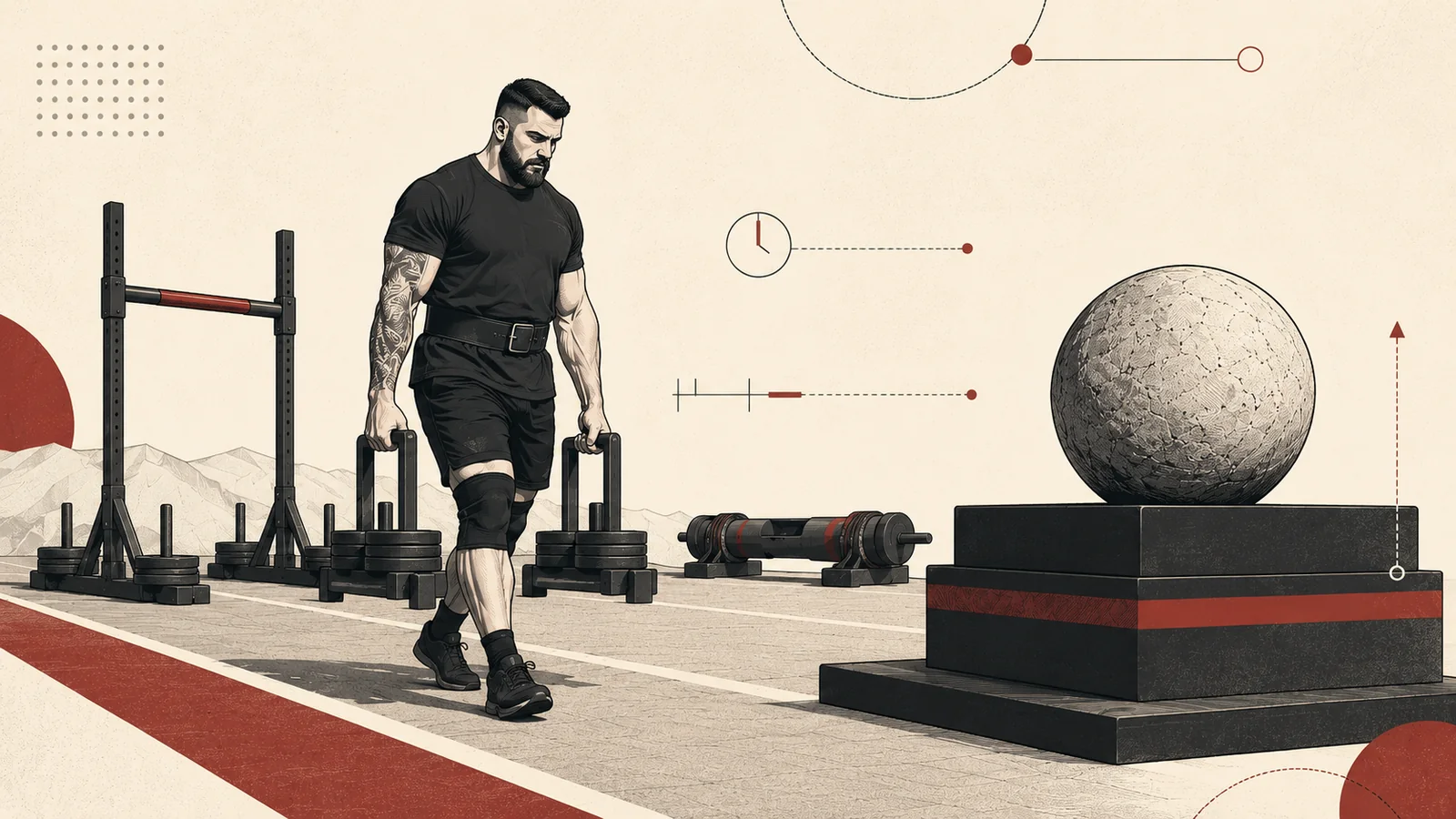
Tracking strongman training does not need to be complicated. Pick the events and exercises you train, record the numbers that matter, and add a short note when the setup could affect the result.
For a farmer’s carry, that might mean the weight, distance, and time, followed by no straps in the notes. For Atlas stones, you may want the weight of each stone, the platform height, and how long the series took. A log press could use the familiar combination of load and reps, with a note about whether you cleaned every rep.
A notebook or spreadsheet can handle all of this. They are useful options, especially if you already have a system you enjoy using. Workout Lab makes the same job easier because you can record several metrics for the same exercise and keep the results together in one history.
The aim is simple: record enough to make a fair comparison next time, but no more than you will use. If logging every detail becomes a chore, the system is too complicated.
Why strongman often needs more than weight and reps
Weight and reps work well for a normal set of squats or deadlifts. Strongman events can also depend on distance, time, height, the implement you used, and the way the event was set up.
A farmer’s walk may ask you to:
- cover a fixed distance as fast as possible;
- travel as far as possible within a time limit;
- complete a course with the heaviest weight you can carry.
Those three versions of the same event need different records. The first needs load, distance, and time. The second needs load, time, and total distance. The third needs the completed load as well as the course and time limit.
The same issue appears across strongman. Atlas stones may use different stone sets and platform heights. A deadlift may use a bar, axle, raised pull, or car apparatus. A throw may be scored by height, distance, or the number of objects cleared. A medley combines several tasks in a set order.
Competition rules can also change what counts as a valid result. Strongman Corporation’s National Records and Standards, for example, includes details such as implement size, time limits, allowed equipment, and judging commands. You do not need to copy a full rulebook into your training log. You only need to keep the details that could change how you compare two attempts.
Keep your strongman training log simple
For every event, start with two questions:
- Which numbers show how I performed?
- Which details would make the next attempt meaningfully different?
The answer to the first question tells you which metrics to record. The answer to the second tells you what belongs in the exercise name or a short note.
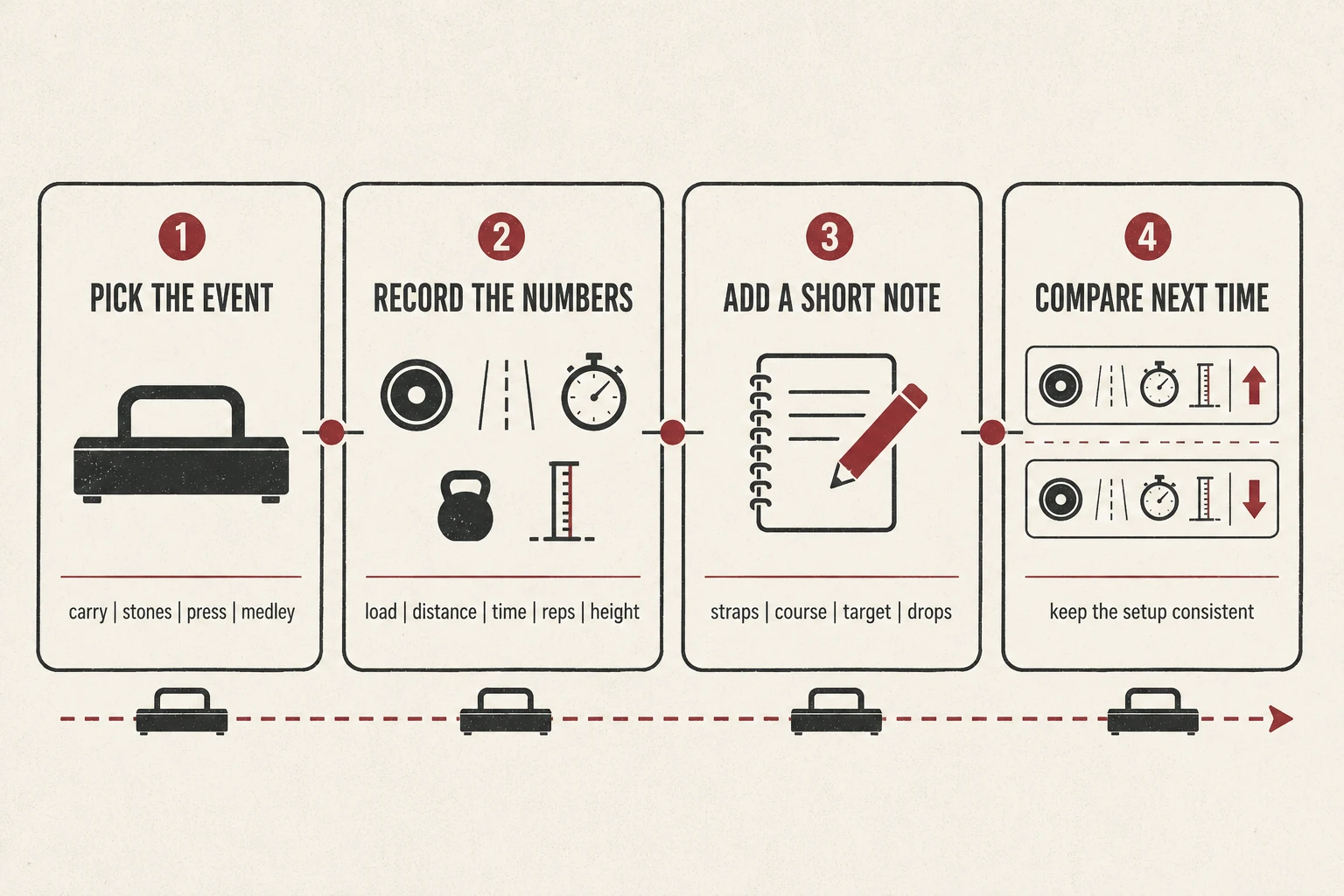
Record the numbers that matter for that event
Choose from:
- load;
- reps or objects completed;
- distance;
- time;
- target or platform height;
- RPE, if you use it.
You will rarely need all of them. A log press for maximum weight may only need load and a successful or failed attempt. A farmer’s carry for time usually needs load, distance, and time. A Hercules hold needs the setup and hold time.
Add the details that could change the comparison
A short note can cover straps, tacky, a belt, sleeves, a wet surface, a turn in the course, or a different platform height. Record these details when they have a real chance of changing the result.
You do not need to write down everything you can remember. If the same yoke, lane, surface, and rules apply every week, put the stable details in the exercise name or routine. Use the session note only when something changes.
For example:
Farmer's Carry | 20 m straight
125 kg per hand | 20 m | 16.8 s
No straps | one drop | dry concrete
That is enough to understand the result and compare it with the next run. You probably do not need a long description of the warm-up, weather, footwear, and every technical mistake unless one of those details matters to your review.
Keep names and units consistent
Choose whether you will record farmer’s carry load per hand or as the total weight of both implements. Either option works. Problems start when one session says 125 kg per hand and the next says 250 kg for the pair without making the difference clear.
Use the same event name, units, and load convention for sessions you want to compare. Create or choose a different event version when the implement, course, target, or rules change enough to make it a different test.
What to record for the main strongman events
The World Strongman International Union’s Standard Disciplines includes deadlift, press, loading, carrying, flipping, curl, armlifting, and weighted bodyweight events. Promoters can change the format and rules, so always check the brief for your competition.
The table below gives you a practical starting point for training.
| Event | Useful numbers | Details worth noting |
|---|---|---|
| Farmer’s walk or frame carry | Load, distance, time, RPE | Per hand or total, implement, turns, surface, straps, drops |
| Yoke carry | Load, distance, time, RPE | Yoke and bar height, course, surface, drops or resets |
| Husafell, shield, sandbag, or keg carry | Object weight, distance, time | Exact object, carry position, pickup, turns, drops |
| Atlas stones | Stone weights, stones loaded, time | Stone order, platform or bar height, tacky, time limit |
| Sandbag, keg, or barrel loading | Object weights, reps or objects, distance, time | Object order, carry distance, target height |
| Log, axle, circus dumbbell, or keg press | Load, reps, time, RPE | Implement, clean method, press rules, equipment |
| Deadlift or squat variation | Load, reps, time, RPE | Bar or apparatus, pull height or squat target, straps, suit, time limit |
| Hercules, farmer, axle, or crucifix hold | Load or setup, hold time | Apparatus, handle, body position, straps or chalk |
| Sled push, drag, or arm-over-arm pull | Load, distance, time | Sled, rope or harness, surface, slope, start and finish |
| Vehicle pull | Distance, time | Vehicle, surface, slope, harness or rope, start method |
| Keg, bag, or weight throw | Load, height, distance, reps, time | Object, bar or line, clearance rule, time limit |
| Tire flip or Fingal’s Fingers | Reps, distance, time | Exact implement, course, valid finish, time limit |
| Medley | Total time and each part’s result | Order, implements, loads, distances, targets, transitions |
You can add more detail when you need it. Start with the smallest useful record and let your training show you what is missing.
How to track different types of strongman events
Carries
For most carries, record load, distance, and time. State whether the load is per hand or total, and note straps, turns, drops, or a different surface when they affect the run.
A straight 20 m farmer’s carry is not the same as 10 m down and 10 m back. The turn costs time and may change your grip or footwork. Keep those course versions separate if you want a clean time comparison.
Stones and other loading events
Record the objects you loaded, their weights, the target height, and the time. For a series, keep the order as well.
Four stones in 60 seconds does not tell you which four stones you completed or where you failed. A useful note might say 110/125/140/155 kg loaded; 170 kg reached lap but missed platform.
Historical stone events have used different numbers of stones, weight ranges, platform heights, and time limits. That variation is why the stone set and target matter when you compare sessions.
Presses, deadlifts, and squats
These events often look more like normal strength training. Load, reps, and RPE may be enough for many sessions.
Add a note when the implement or rules change. A log press from the floor differs from a press taken from a rack. An axle deadlift from the floor differs from an elevated pull. A car deadlift apparatus cannot be compared directly with a barbell using the listed weight alone.
Holds, sleds, drags, and vehicle pulls
A hold usually needs the setup and total time. Sleds, drags, and vehicle pulls usually need distance and time, with the load added when it is useful.
Keep the apparatus and surface consistent. A sled loaded with the same plates can feel very different on rubber flooring, concrete, or rough tarmac. Vehicle weight also does not tell you the exact resistance of a pull because tyres, slope, surface, and the starting method all matter.
Throws
Record the object and the result the event uses: height, distance, or objects cleared within a time limit. Add attempts or misses if they help you understand the session.
If your training app does not have a suitable height field, put the bar height in the exercise name or note. Do not force it into an unrelated field just to keep everything numeric.
Medleys
Record the total result first, then the parts that will help you review it. For a sandbag carry followed by a sled drag, that may mean total time, carry time, transition time, and drag time.
You do not need perfect split timing in every training session. Use it when the total time alone hides what changed. If the medley got faster while the sled drag got slower, the carry or transition must have improved enough to make up the difference.
Compare the same event under similar conditions
You only need enough consistency to know that you are testing roughly the same thing.
Before calling a result a personal best, check:
- Did you use the same event and implement?
- Was the load recorded in the same way?
- Was the distance, course, or target the same?
- Were straps, tacky, drops, and other important rules the same?
- Did you perform one attempt fresh and the other at the end of a medley?
If the important details match, compare the results directly. If something changed, keep the result and note the difference under another version of the event.
This matters most when you practise for a competition. Use the organizer’s rules for the event, including how incomplete attempts and ties are scored. A gym stone PR to a lower platform may be a good training result, but it does not replace a competition result to the stated height.
Four simple logging examples
Farmer’s carry
Farmer's Carry | 20 m straight
125 kg per hand | 20 m | 16.8 s | RPE 8.5
No straps | dry concrete | one drop at 14 m
If you later complete the same setup in 15.9 seconds, you have a clear time improvement. A faster run over 15 m or with different handles belongs in a separate comparison.
Atlas stone series
Atlas Stones | 5 stones | 48 in platform | 60 s
110 / 125 / 140 / 155 kg loaded
170 kg reached lap but missed platform | RPE 10
Next time, 5/5 in 56.4 seconds is a clear improvement under the same setup. If both attempts are incomplete, follow the scoring method used for the event rather than assuming time always settles the result.
Yoke carry
Yoke Carry | 20 m straight
360 kg | 20 m | 14.6 s | RPE 9
Same yoke and bar height | dry concrete | no drops
A change in the yoke or bar height can affect the pick and carrying position. Note it or use a separate version when the change is large enough to matter.
Carry-and-drag medley
Sandbag Carry + Sled Drag | 15 m + 15 m
Total: 35.4 s
Sandbag: 120 kg | 12.8 s
Transition: 2.6 s
Sled: 220 kg listed load | 20.0 s
The total tells you whether the full medley improved. The three times underneath show where you gained or lost those seconds.
How to review your progress
You do not need to study every number after every workout. Look through your log at the end of the week or training block and choose the events that matter most to your current goal or next competition.
For each one, ask:
- Did I repeat the same setup often enough to compare it?
- Did the result improve through more load, more reps or distance, a higher target, or less time?
- Is there one note that helps explain the change, such as fewer drops or a faster transition?
Keep different improvements separate. A faster farmer’s carry, a heavier yoke, and a longer hold can all show progress. You do not need to combine them into one strongman score.
Simple calculations can help when the setup stays the same. You may follow carry speed, reps per minute, or the time spent on each part of a medley. Keep the original load, distance, reps, and time beside any calculation so you can still see what you did.
For a broader weekly and block review process, see how to review your training data.
How Workout Lab makes strongman tracking easier
Paper and spreadsheets work. Many gym logs, however, are built mainly around weight and reps. Workout Lab lets you select several metrics for the same exercise and keeps those results in one training history.
A farmer’s carry can include load, distance, and time. A log press can use load and reps. A hold can use time. You can then add RPE and a short note where they are useful. A spreadsheet can do the same with custom columns. Workout Lab keeps those fields connected to the exercise and the rest of your workout history.
Search before creating a new exercise
Workout Lab has a shared exercise library. Search it before adding anything new. If you need a repeatable event version that is not there, use a clear name such as:
Farmer's Carry | 20 m straight | no straps
Atlas Stones | 5 stones | 48 in platform
Yoke Carry | 20 m straight | same yoke
New exercises become public and cannot be edited later, so avoid creating one for temporary details such as wet ground or a one-off rule change. Put those details in the workout note instead. After the 30-day Pro trial, creating custom exercises and using analytics requires Pro.
Keep the numbers in fields and the setup in a short note
Use the available fields for load, reps, distance, time, and RPE. Put details such as per hand, straps, tacky, platform height, and surface in the name or note.
Workout Lab does not currently have dedicated strongman fields for every implement and rule. It also does not time splits automatically, import competition events, calculate vehicle resistance, or score medleys for you. You still decide what matters and record it. The app makes that record easier to organise and compare.
Exercise Analysis can show how a selected exercise changes over time. The chart is most useful when the exercise name and setup stay consistent. If one farmer’s carry entry contains several courses, handles, and strap rules, the graph will mix results that do not belong together.
The custom exercise library guide explains more about flexible exercise tracking across different sports.
A simple strongman training log template
Use this in Workout Lab, a spreadsheet, or a notebook:
Date:
Event or exercise:

Result
Load:
Reps or objects completed:
Distance:
Time:
Height:
RPE:

Useful details
Implement or object:
Course or target:
Straps, tacky, belt or sleeves:
Drops, misses or anything that changed:
Leave any field you do not need blank. If your log takes longer to complete than the event itself, simplify it.
Choose one event from your next session and record the result with the few details you will need to compare it again. Start with Workout Lab if you want to keep several metrics, notes, and exercise history together.
Sources
- Strongman Corporation, National Records and Standards, accessed 2026-07-26.
- Strongman Corporation, Rules and Records, accessed 2026-07-26.
- Strongman Archives, Farmer’s Walk, Stones, and Medley, accessed 2026-07-26. These historical listings show how event formats vary rather than setting rules for every competition.
- World Strongman International Union, Standard Disciplines, accessed 2026-07-26.
- Workout Lab, Guide by Athlete Type, Workouts & Routines, and Data Analysis & Insights, checked 2026-07-26.
Start Tracking Your Progress
Turn your training data into actionable insights with Workout Lab.
Get Started FreeRelated Articles
How to Track HYROX Training: Runs, Stations, and RPE
Learn how to log HYROX runs, stations, mixed sessions, and preparation exercises without turning your training into a spreadsheet project.
How to Measure Mobility Progress: A Repeatable ROM Tracking System
Learn how to measure mobility progress with standardized ROM targets, repeatable exercises, and session data instead of occasional photos and guesswork.
Your Workout Week in Data: How Automated Weekly Reports Surface What's Actually Happening
A weekly workout report surfaces volume trends, RPE patterns, and Est. 1RM trajectory automatically. Here's what to track and how to act on it.