Hypertrophy & Strength Analysis
How Workout Lab uses cutting-edge research to evaluate your training volume and frequency for optimal muscle growth and strength gains.
Workout Lab’s Hypertrophy and Strength Analysis is built on the most comprehensive meta-regression to date on resistance training dose-response relationships.
The Science Behind It
The analysis is based on Pelland et al. (2024); a meta-regression of 67 studies with 2,058 participants that explored how weekly training volume and frequency affect muscle hypertrophy and strength gains.
What makes this research unique:
- Non-linear analysis: Captures diminishing returns curves that linear models miss.
- Fractional set counting: Distinguishes between direct and indirect muscle stimulation.
- Multiple model comparison: Tested 7 different mathematical models to find the best fit.
- Failure-based training: Analyzed studies where sets were performed to or near failure.
Citation
Pelland, J., Remmert, J., Robinson, Z., Hinson, S., & Zourdos, M. (2024). The Resistance Training Dose-Response: Meta-Regressions Exploring the Effects of Weekly Volume and Frequency on Muscle Hypertrophy and Strength Gain. SportRxiv.
How Sets Are Counted
The app uses the fractional counting method, which the research showed to be the most accurate predictor of training outcomes.
| Set Type | Count | Example |
|---|---|---|
| Direct set | 1.0 | Bench Press for chest hypertrophy. |
| Indirect set | 0.5 | Tricep Pushdown for chest hypertrophy. |
Direct sets target the muscle as the primary force generator. Indirect sets train the muscle as a synergist.
Why Only RPE ≥ 8?
The research analyzed studies where participants trained to or near failure. In the app, only sets with RPE ≥ 8 (Rate of Perceived Exertion) count toward the analysis because:
- RPE 8 = approximately 2-3 reps in reserve.
- Sets below this threshold don’t provide the same hypertrophic or strength stimulus.
- This aligns with the “proximity to failure” requirement from the research.
Volume Effects on Hypertrophy vs Strength
The chart below shows the dose-response relationship between weekly set volume and muscle adaptations. Notice how hypertrophy continues to increase (blue curve), while strength quickly plateaus (orange curve).
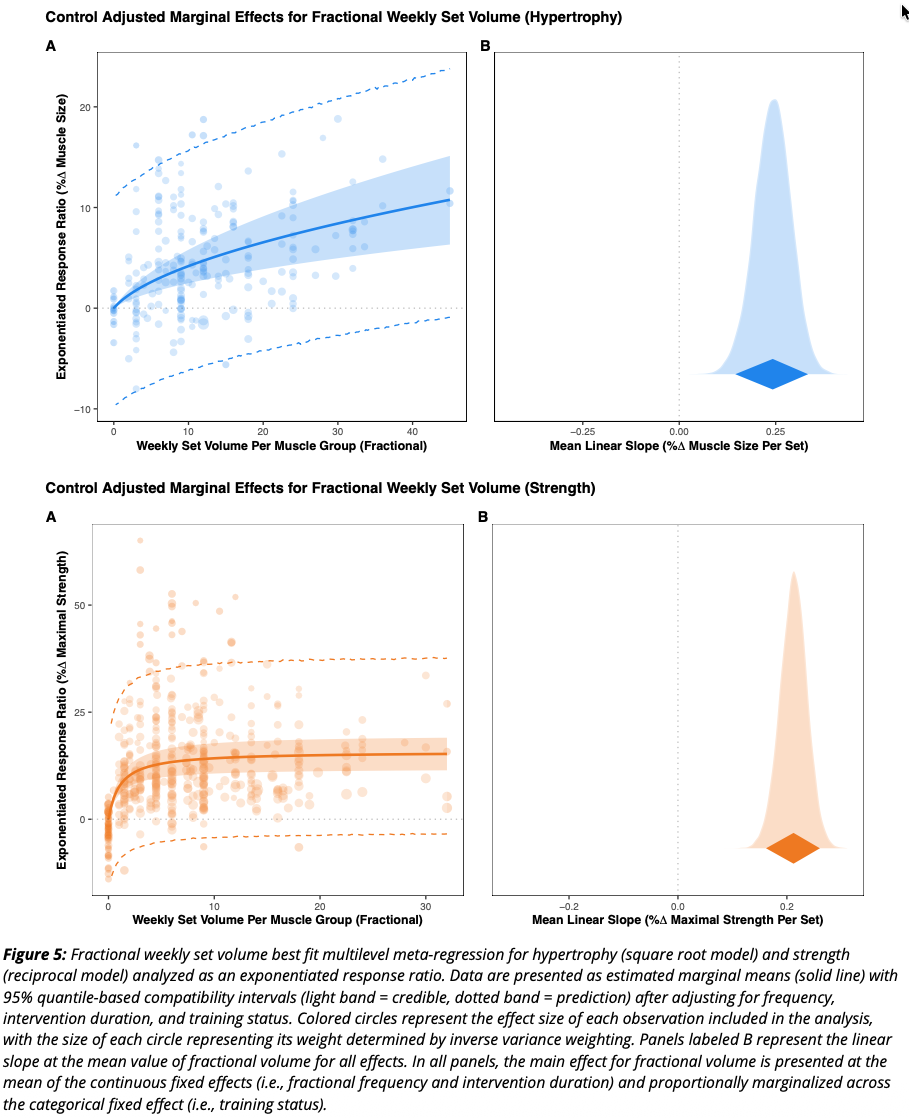
Figure: Fractional weekly set volume meta-regression. Hypertrophy (blue) follows a square root model with continuous gains. Strength (orange) follows a reciprocal model with a functional plateau.
Hypertrophy Analysis
What the Research Shows
Volume is king for hypertrophy. The dose-response curve shows:
- More weekly sets = more muscle growth.
- Diminishing returns as volume increases (but no plateau has been observed).
- No inverse-U relationship; we haven’t found a point where more work hurts gains.
- Frequency has limited impact; concentrate on accumulating sets that you can recover from.
Volume Efficiency Tiers
Based on the research, the app classifies your weekly volume per muscle group:
| Classification | Weekly Sets | Efficiency |
|---|---|---|
| Minimum | ~4 sets | Sufficient to elicit detectable hypertrophy. |
| Moderate | 5-10 sets | ~6 additional sets needed per incremental gain. |
| High | 11-18 sets | ~8.5 additional sets needed per incremental gain. |
| Very High | 19-29 sets | ~10.75 additional sets needed per incremental gain. |
| Extreme | 30+ sets | Diminishing returns continue, monitor recovery. |
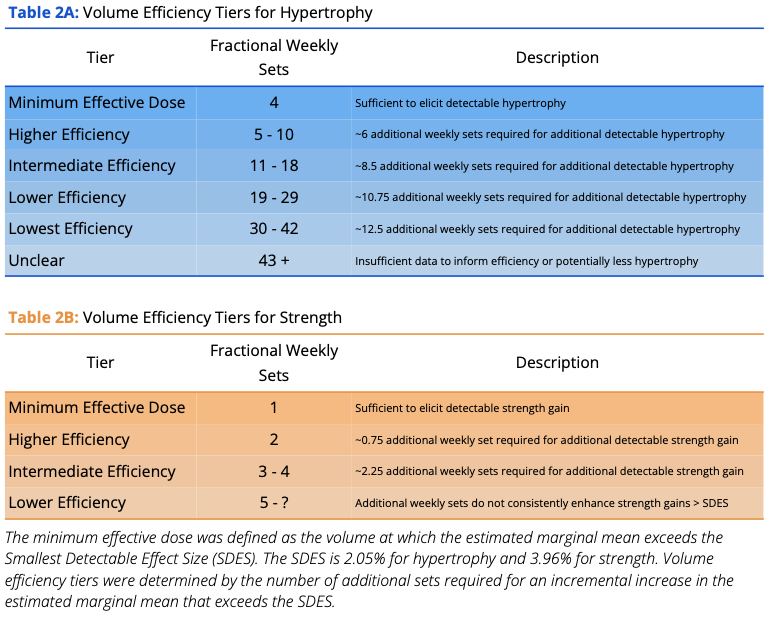
Tables 2A and 2B from Pelland et al. (2024): Volume efficiency tiers based on smallest detectable effect sizes.
Key insight: The first 10 sets have the largest effect. Beyond that, progress continues at a slower rate. There’s no upper limit where gains reverse; it is purely about recovery capacity.
Practical Recommendation
For hypertrophy:
- Aim for 10-20 sets per muscle group per week.
- Spread them however works for your schedule and recovery.
- Focus on high effort (RPE ≥ 8) rather than junk volume.
- More is better if you can handle it.
Strength Analysis
What the Research Shows
Strength responds differently than hypertrophy:
- Volume plateaus quickly; only 3-5 sets per week are needed for strength gains.
- Frequency is important: spreading sets across more sessions improves strength.
- Strength is skill-specific; practicing the movement pattern frequently at high intensity is key.
Volume Efficiency Tiers
| Classification | Weekly Sets | Efficiency |
|---|---|---|
| Minimum | 1 set | Sufficient to elicit detectable strength gain. |
| Optimal | 2 sets | ~0.75 additional sets per incremental gain. |
| Adequate | 3-4 sets | ~2.25 additional sets per incremental gain. |
| Diminishing | 5+ sets | Additional sets don’t consistently enhance gains. |
Key insight: Pure strength requires relatively little volume but benefits from high intensity and frequency.
Why Frequency Matters for Strength
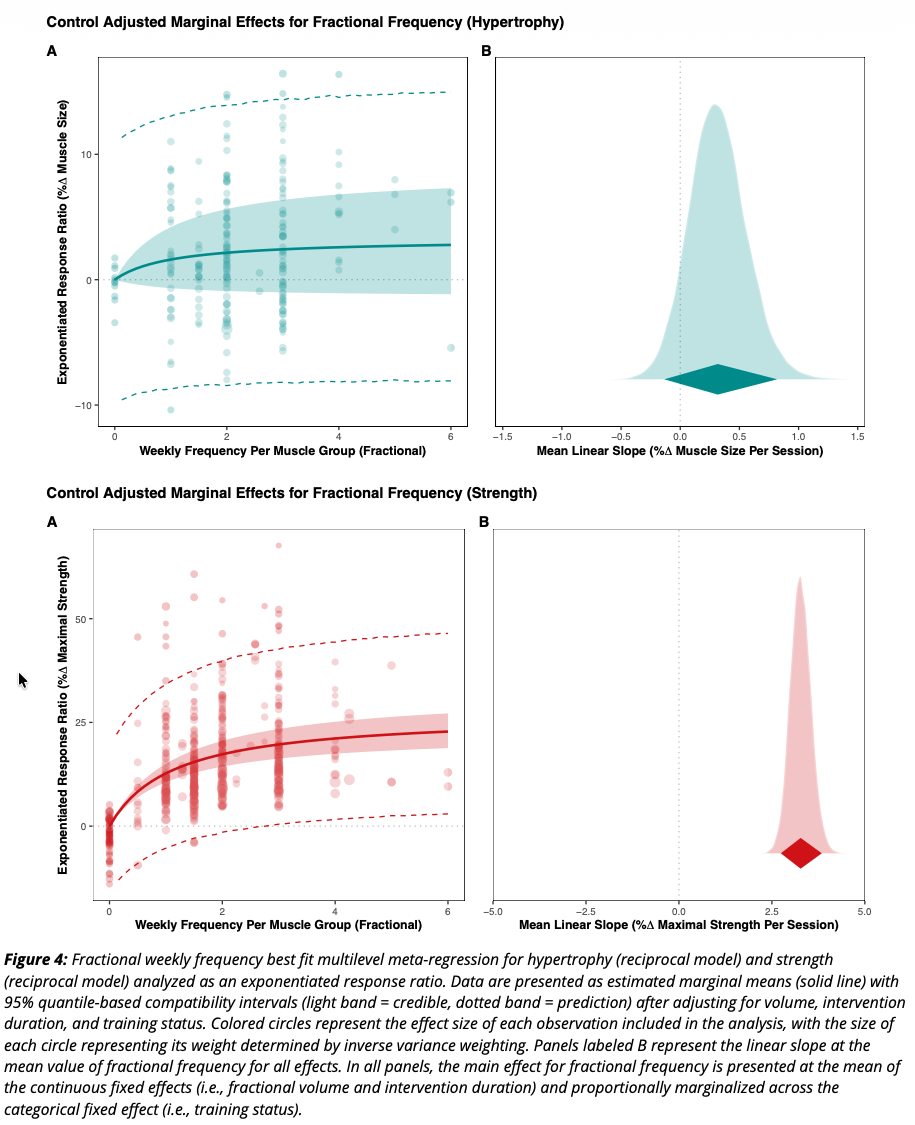
Figure: Fractional weekly frequency meta-regression. Hypertrophy (teal) shows negligible frequency effects. Strength (red) shows strong positive effects from higher frequency.
The research showed a 100% probability that higher frequency improves strength (with diminishing returns). This is because:
- Neural adaptations: Strength involves training the nervous system to recruit muscles efficiently.
- Skill acquisition: Heavy lifting is a motor skill that improves with practice.
- Freshness: Performance is highest when not fatigued.
- Technique: Frequent exposure reinforces proper movement patterns.
Practical Recommendation
For strength:
- Train each lift 2-4× per week for best results.
- Keep volume low per session (1-3 heavy sets).
- Prioritize intensity (≤ 5 reps) over volume.
- Train fresh: prioritize strength work early in your sessions.
Combining Strength and Hypertrophy
From this research, we can infer that an optimal structure for athletes who want both strength and hypertrophy would look something like this:
Per Session Template
-
Strength work first (when fresh).
- 1-3 sets of 1-5 reps at very high intensity.
- RPE 8-10.
- Focus on technique and maximum recruitment.
- Keep fatigue low.
-
Hypertrophy work second.
- Higher rep ranges (6-15 reps).
- RPE 8-9.
- Focus on accumulating enough volume for muscle growth.
How the App Analyzes Your Training
Hypertrophy Analysis (Per Muscle Group)
The Weekly Report calculates:
- Total direct sets (RPE ≥ 8) → counted as 1.0.
- Total indirect sets (RPE ≥ 8) → counted as 0.5.
- Sum = fractional weekly volume.
- Classification based on efficiency tiers.
- Personalized recommendations to optimize volume.
Strength Analysis (Per Exercise)
The Weekly Report calculates:
- Total sets with RPE ≥ 8 AND ≤ 5 reps.
- Number of sessions where the exercise was performed.
- Frequency recommendation based on the dose-response curve.
- Volume assessment (are you in the optimal 1-4 set range?).
Key Takeaways
| Goal | Volume | Frequency | Intensity |
|---|---|---|---|
| Hypertrophy | More is better (10-20+ sets/week) | Doesn’t matter much | RPE ≥ 8. |
| Strength | Less is more (3-5 sets/week) | Higher is better | RPE ≥ 8, ≤ 5 reps. |
The bottom line:
- For muscle growth, accumulate volume however you can recover.
- For strength, practice the lift often with low fatigue and high intensity.
- For both, train close to failure (RPE ≥ 8); sub-maximal sets have a reduced impact on these metrics.